

ST.JOSEPH’S – It may have been a celebration 75 years in the making, but it was well worth the wait.
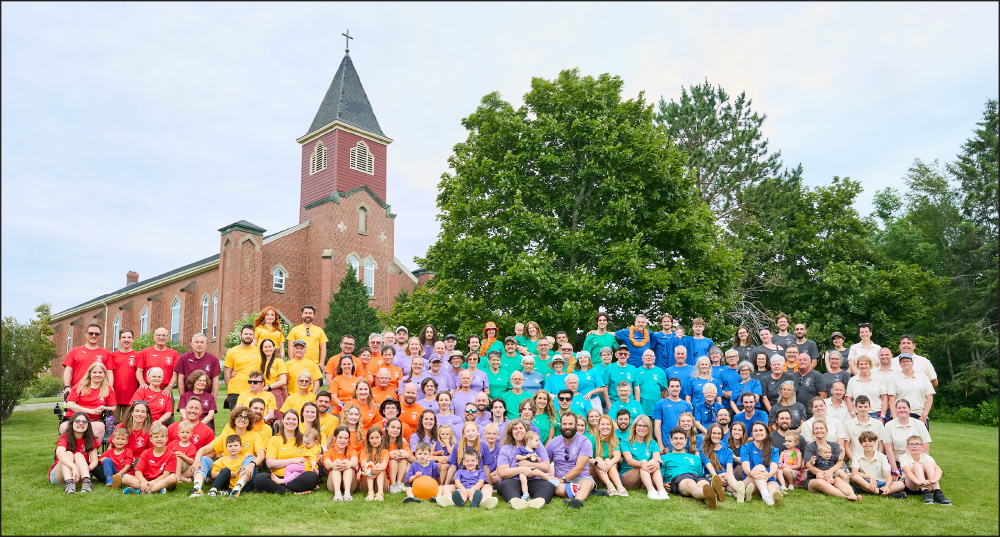
Earlier this month – from July 17-19 – more than 150 members of the VanBerkel family gathered here to commemorate a pioneering moment in their rich history.
In 1951, Adrian Sr. and Johanna VanBerkel, with their eight children, arrived in Canada – specifically, what would become their Glen Rd. farm – after coming from their native Netherlands.
“Everything went very well – no glitches,” Adrian Jr. – one of the surviving siblings – told The Journal of the recent three-day gathering.
Describing the festivities as “well planned,” he praised members of the “next generation,” who formed a committee two years ago, for creating and executing the plan.
Reflecting on circumstances of his family’s arrival in Canada – Adrian Jr. was five months old at the time – he explained that Dutch farmers started coming to Canada in the late 1940s. Some families received a loan from the provincial government, along with the opportunity to carry out their vocation; others were sponsored by the Catholic Church, including the Diocese of Antigonish, which worked in tandem with the StFX Extension Department. Some families were sponsored by individual farmers.
“They sent representatives to Quebec City to meet the immigrant ship which had 1,500 aboard, mostly Dutch immigrants, and try to persuade some Dutch Catholic farmers to come to northeastern Nova Scotia,” VanBerkel said, noting they were in search of Catholic farmers – ones “preferably having a family with many children.”
He added, with a laugh, “We fit the criteria.”
VanBerkel explained that was the beginning of the influx of Dutch immigrant farmers during the 1950s.
“We were also the first Dutch family to settle in the St. Joseph’s parish community,” he noted of their arrival on Glen Rd., where they rented a farm. Almost four years later, the couple made the transition to Salt Springs, where they settled and owned their property.
Although “some moved on,” VanBerkel indicated many families – like theirs – settled in northeastern Nova Scotia and Cape Breton, planting their roots in this region, pioneers who became pillars of their communities, while welcoming more children as they settled in their adopted homes.
“It was a major decision,” he said of his parents’ life-changing mood, while noting that Adrian Sr. was “making a good living in Holland.”
But, as VanBerkel explained, the government in their home country was “actively encouraging” residents to consider taking advantage of the opportunities offered in Canada.
“They realized there were too many farmers, and not enough land,” he added, while noting those who made the leap found the opposite situation here.
Along with a “fear of the spread of communism,” which was making its way across Europe at the time, the younger VanBerkel noted a “sense of adventure” that his parents and other Dutch immigrants possessed.
And, he added, “They anticipated that things would be better [in Canada].”
And they were.
More than 150 members gathered – with the St. Joseph’s Lakeside Community Centre serving as home base – to celebrate their family’s pioneering roots, with some arriving from as far away as Ontario, Alberta, and Hong Kong, along with “extended family” from Holland.
“There were many people who hardly knew each other,” VanBerkel noted, which necessitated reunion goers wearing name tags.
On Friday morning, everyone gathered at the centre and then participated in a walk through Saint Joseph’s Hillside Cemetery, where Adrian Sr. and Johanna rest. Adrian Jr. provided a brief family history, which preceded the planting of a remembrance tree.
“People took turns placing a bit of dirt to help fill the hole,” VanBerkel said, noting that the shovel they used came from the Netherlands, which he described as “very interesting.”
They spent Friday evening carrying out preparations, such as decorating the hall – with the adornments including a family tree and its many branches that greeted visitors when they arrived.
Saturday activities offered plenty of fun, including outdoors activities; and, of course, plenty of food. Along with barbecue fare, which he described as “more Canadian style,” VanBerkel said the menu throughout the day included traditional Dutch favourites such as stamppot – a combination of mashed potatoes, kale and sausages – along with cheese and pickled fish. There was also pea soup, which VanBerkel offered is “very Dutch,” along with hamburger ball soup, which the grandchildren called “Oma soup.”
“We are big on coffee,” he said of the Dutch favourite, noting how his parents had an adjustment to make when they arrived in Antigonish County, where they discovered mostly Scottish tea drinkers.
And, of course, the menu included “plenty of stories and conversation.”
On Sunday, after completing some clean-up at the community centre, family members visited his home where a lot of artifacts were displayed. Youngsters also had the opportunity to select a name for a resident pig. They settled on Wilbur.
In keeping with their Dutch roots, when it comes to sports, family members wrapped up the weekend reunion watching the 2026 World Cup soccer final featuring Argentina and Spain, who ended up hoisting the international crown.
“It was an amazing weekend – I think everyone had a great time,” VanBerkel said.